


melidosData helps you load data from the MeLiDos field
study. It also contains helpers to work with REDCap
dictionaries and metadata.
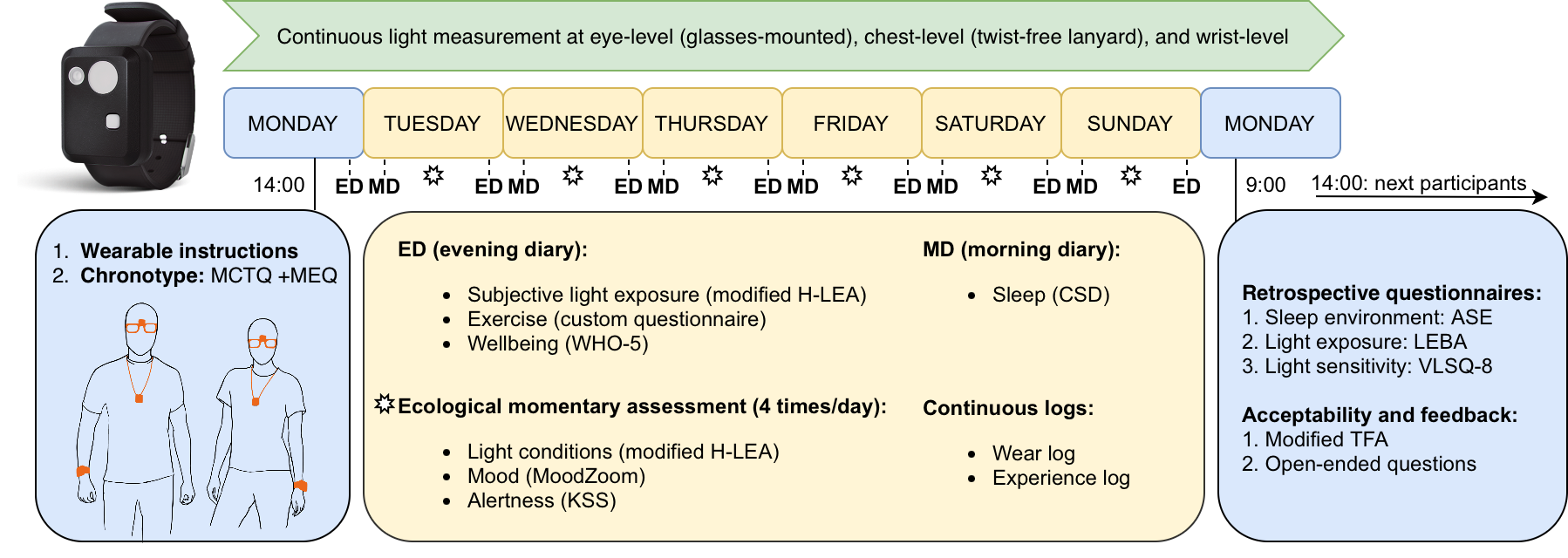
The MeLiDos field study datasets contain wearable data for personal light exposure at the eye, chest, and wrist level for 191 participants across 9 sites and 7 countries, capturing 1480 participant days of annotated data. Through a host of questionnaires at screening and discharge time, ecological momentary assessment, diaries, and logs, extensive auxiliary data are available.
load_data() downloads a modality for one or many
sites.flatten_data() combines multi-site lists into one
analysis-ready table, including a shared timezone.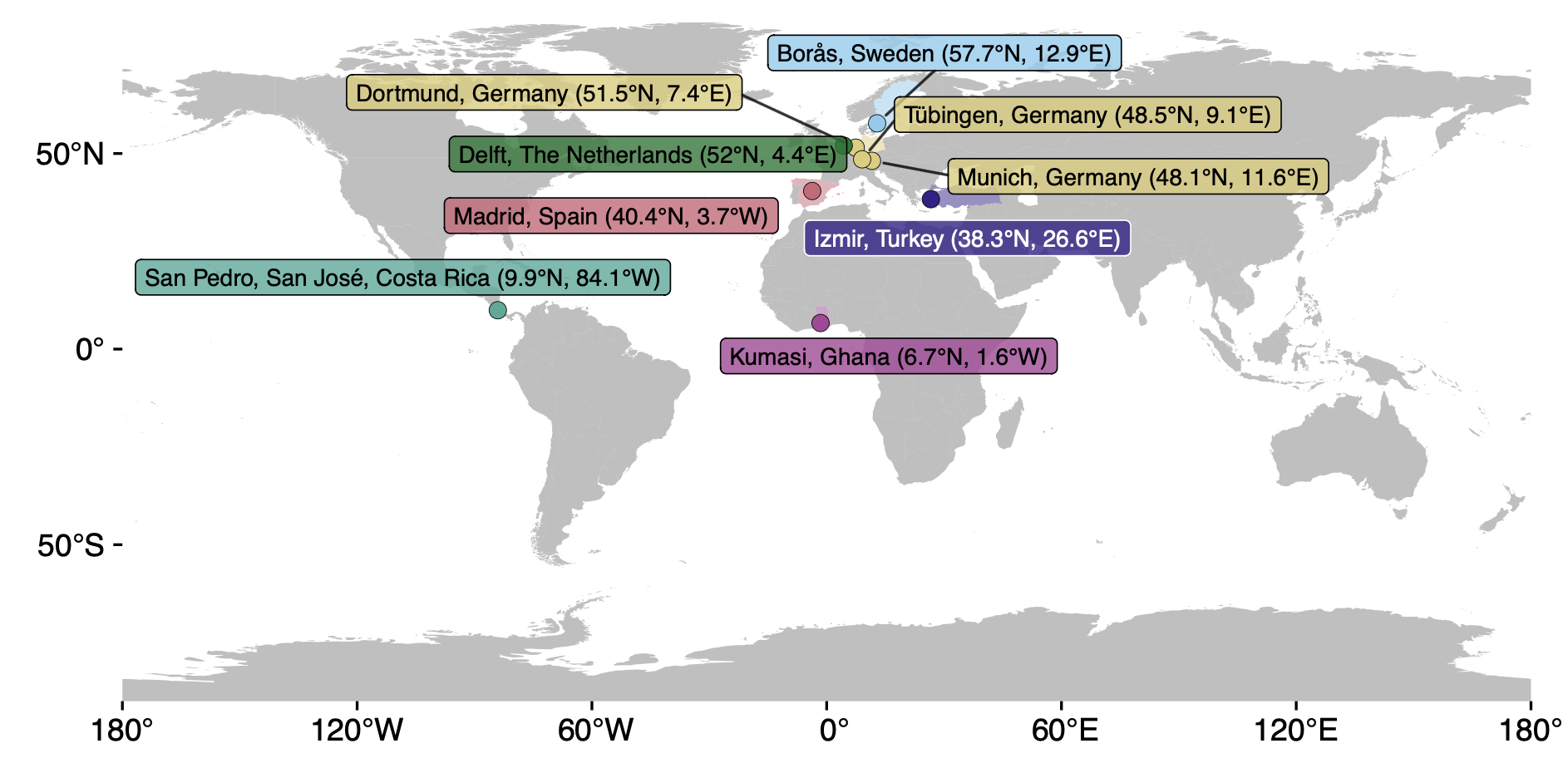
| Institution (site Abbr.) | City | Country | Repository | DOI |
|---|---|---|---|---|
| RISE | Borås | Sweden | NilssonTengelinEtAl_Dataset_2026 | 10.5281/zenodo.18925834 |
| THUAS | Delft | The Netherlands | AertsEtAl_Dataset_2025 | 10.5281/zenodo.17979893 |
| BAUA | Dortmund | Germany | BroszioEtAl_Dataset_2025 | 10.5281/zenodo.18111232 |
| MPI | Tübingen | Germany | GuidolinEtAl_Dataset_2025 | 10.5281/zenodo.16895188 |
| TUM | Munich | Germany | HildenEtAl_Dataset_2025 | 10.5281/zenodo.16893901 |
| FUSPCEU | Madrid | Spain | BaezaEtAl_Dataset_2025 | 10.5281/zenodo.16834951 |
| IZTECH | Izmir | Turkey | DidikogluEtAl_Dataset_2025 | 10.5281/zenodo.16568109 |
| UCR | San José | Costa Rica | Sancho-SalasEtAl_Dataset_2025 | 10.5281/zenodo.17289456 |
| KNUST | Kumasi | Ghana | AkuffoEtAl_Dataset_2025 | 10.5281/zenodo.15576731 |
Overview of the available sites in the package
You can install the CRAN version of melidosData with:
install.packages("melidosData")You can install the development version of melidosData from GitHub with:
# install.packages("pak")
pak::pak("MeLiDosProject/melidosData")library(melidosData)
library(LightLogR) #for visualization
library(dplyr) #for data manipulation
# one site -> data frame
sleep_tum <- load_data("sleepdiaries", site = "TUM")
sleep_tum |> select(Id, sleep, wake) |> head()
#> # A tibble: 6 × 3
#> Id sleep wake
#> <chr> <dttm> <dttm>
#> 1 TUM_S001 2024-05-14 00:25:00 2024-05-14 09:38:00
#> 2 TUM_S001 2024-05-15 00:17:00 2024-05-15 08:00:00
#> 3 TUM_S001 2024-05-16 00:32:00 2024-05-16 10:00:00
#> 4 TUM_S001 2024-05-17 01:25:00 2024-05-17 09:30:00
#> 5 TUM_S001 2024-05-18 00:35:00 2024-05-18 09:30:00
#> 6 TUM_S001 2024-05-19 05:32:00 2024-05-19 11:30:00
# many sites -> `melidos_data` list
sleep_all <- load_data("sleepdiaries", site = c("TUM", "UCR"))
sleep_all |> summary()
#> Length Class Mode
#> TUM 14 tbl_df list
#> UCR 14 tbl_df list
# flatten list output for analysis
sleep_all_flat <- flatten_data(sleep_all, tz = "UTC")
sleep_all_flat |>
select(site, Id, sleep, wake) |>
group_by(site) |>
slice_head(n=3)
#> # A tibble: 6 × 4
#> # Groups: site [2]
#> site Id sleep wake
#> <chr> <chr> <dttm> <dttm>
#> 1 TUM TUM_S001 2024-05-14 00:25:00 2024-05-14 09:38:00
#> 2 TUM TUM_S001 2024-05-15 00:17:00 2024-05-15 08:00:00
#> 3 TUM TUM_S001 2024-05-16 00:32:00 2024-05-16 10:00:00
#> 4 UCR UCR_S001 2025-06-16 21:35:00 2025-06-17 06:36:00
#> 5 UCR UCR_S001 2025-06-17 21:35:00 2025-06-18 06:30:00
#> 6 UCR UCR_S001 2025-06-18 22:25:00 2025-06-19 06:40:00The following list of modalities contains the modality codes to be
used in load_data().
light_glasses, light_chest,
light_wrist: personal light exposure datasets, captured with
ActLumus devices, recorded in 10 second intervals for the
eye-level, chest-level, and wrist-level position. Data are minimally
checked after import (range, explicit gaps, device malfunctions, time
shifts).
light_glasses_1minute, light_chest_1minute, light_wrist_1minute: as above, but aggregated to 1-minute intervals. Furthermore, days with less than 80% of data coverage are removed. This makes the datasets both faster to download, computationally easier to work with, and also more stable to calculate light exposure metrics
load_data() follows main by default. Supply
ref as a full commit SHA, or as a named character vector of
SHAs by site, to use fixed source versions. The
melidos_sources attribute records the requested
repositories, revisions, URLs, object names, and load status. A branch
name is not an immutable version.
Failed downloads or missing objects now stop with an informative
error. on_failure = "warn" retains failed sites as
NULL for inspection; flatten_data() rejects
these entries rather than silently reducing the sample. For a failed
single site, the result is a one-element melidos_data list
so that source metadata remain available. MPI’s unavailable health,
chest and wrist modalities remain explicitly omitted.
flatten_data() defaults to
time_mode = "clock", preserving each site’s local clock
readings while changing the represented instants. For device or diary
alignment on an absolute time axis, use
time_mode = "instant"; this preserves instants and
expresses them in the requested tz. Keep site-specific time
zones available when deriving local dates, sleep windows or clock-time
summaries. For clock comparisons, tz = "UTC" avoids
daylight-saving gaps that can otherwise turn nonexistent local times
into NA.
Expanded REDCap checkbox columns remain separate in
REDCap_factors(). Both field___code and
field_code names are supported, with Unchecked
and Checked factor levels and a
checkbox_choice attribute for the option label. This
preserves simultaneous selections; a single choice factor cannot do
so.
The nine sites are centered on universities and research institutes. The packages contains relevant metadata for these sites:
melidos_countries
#>              RISE           FUSPCEU              BAUA               TUM
#>          "Sweden"           "Spain"         "Germany"         "Germany"
#>               MPI             THUAS            IZTECH             KNUST
#>         "Germany" "The Netherlands"          "Turkey"           "Ghana"
#>               UCR
#>      "Costa Rica"
melidos_cities
#>                  RISE               FUSPCEU                  BAUA
#>               "Borås"              "Madrid"            "Dortmund"
#>                   TUM                   MPI                 THUAS
#>              "Munich"            "Tübingen"               "Delft"
#>                IZTECH                 KNUST                   UCR
#>               "Izmir"              "Kumasi" "San Pedro, San José"
melidos_colors
#>      RISE   FUSPCEU      BAUA       TUM       MPI     THUAS    IZTECH     KNUST
#> "#88CCEE" "#CC6677" "#DDCC77" "#DDCC77" "#DDCC77" "#117733" "#332288" "#AA4499"
#>       UCR
#> "#44AA99"
melidos_coordinates
#> $RISE
#> [1] 57.71567 12.89087
#>
#> $FUSPCEU
#> [1] 40.41650 -3.70256
#>
#> $BAUA
#> [1] 51.498204  7.416708
#>
#> $TUM
#> [1] 48.1333 11.5667
#>
#> $MPI
#> [1] 48.5216  9.0576
#>
#> $THUAS
#> [1] 52.0116  4.3571
#>
#> $IZTECH
#> [1] 38.32 26.63
#>
#> $KNUST
#> [1]  6.675007 -1.572644
#>
#> $UCR
#> [1]   9.9372 -84.0509
melidos_tzs
#>                 RISE              FUSPCEU                 BAUA
#>   "Europe/Stockholm"      "Europe/Madrid"      "Europe/Berlin"
#>                  TUM                  MPI                THUAS
#>      "Europe/Berlin"      "Europe/Berlin"   "Europe/Amsterdam"
#>               IZTECH                KNUST                  UCR
#>    "Europe/Istanbul"       "Africa/Accra" "America/Costa_Rica"
More information is found under the full repository of each dataset on the project page.
# 1) load dictionary and clean labels
codebook_path <- system.file("ext", "DataDictionary_sleepdiary.csv", package = "melidosData")
codebook <- utils::read.csv(codebook_path, check.names = FALSE)
codebook_clean <- REDCap_codebook_prepare(codebook)
codebook_clean |> names()
#>  [1] "Variable / Field Name"
#>  [2] "Form Name"
#>  [3] "Section Header"
#>  [4] "Field Type"
#>  [5] "Field Label"
#>  [6] "Choices, Calculations, OR Slider Labels"
#>  [7] "Field Note"
#>  [8] "Text Validation Type OR Show Slider Number"
#>  [9] "Text Validation Min"
#> [10] "Text Validation Max"
#> [11] "Identifier?"
#> [12] "Branching Logic (Show field only if...)"
#> [13] "Required Field?"
#> [14] "Custom Alignment"
#> [15] "Question Number (surveys only)"
#> [16] "Matrix Group Name"
#> [17] "Matrix Ranking?"
#> [18] "Field Annotation"

# 2) start with example REDCap export
sleep <- REDCap_example_sleep
sleep$sleepquality #original
#> [1] 3 3 2 5 2 3 3 2 4

# 3) check expected column types against dictionary metadata
check <- REDCap_coltype_check(codebook_clean, data = sleep)
check$ok
#> [1] TRUE
check$details
#> # A tibble: 16 × 6
#>    col              expected  present actual    type_ok issue
#>    <chr>            <chr>     <lgl>   <chr>     <lgl>   <chr>
#>  1 bedtime          POSIXct   TRUE    POSIXct   TRUE    ok
#>  2 sleep            POSIXct   TRUE    POSIXct   TRUE    ok
#>  3 offset           POSIXct   TRUE    POSIXct   TRUE    ok
#>  4 out_ofbed        POSIXct   TRUE    POSIXct   TRUE    ok
#>  5 sleepdelay       numeric   TRUE    numeric   TRUE    ok
#>  6 awakenings       numeric   TRUE    numeric   TRUE    ok
#>  7 awake_duration   numeric   TRUE    numeric   TRUE    ok
#>  8 sleepquality     numeric   TRUE    numeric   TRUE    ok
#>  9 daytype2         numeric   TRUE    numeric   TRUE    ok
#> 10 status           numeric   TRUE    numeric   TRUE    ok
#> 11 scheduledate     Date      TRUE    Date      TRUE    ok
#> 12 record_id        character TRUE    character TRUE    ok
#> 13 comments         character TRUE    character TRUE    ok
#> 14 uuid             character TRUE    character TRUE    ok
#> 15 supplementaldata character TRUE    character TRUE    ok
#> 16 serializedresult character TRUE    character TRUE    ok

# 4) convert factor numbers into factors
sleep_factors <- REDCap_factors(sleep, codebook_clean)
sleep_factors$sleepquality #factors
#> [1] Fair      Fair      Poor      Very good Poor      Fair      Fair
#> [8] Poor      Good
#> Levels: Very poor Poor Fair Good Very good

# 5) attach human-readable labels from dictionary
sleep_labelled <- REDCap_col_labels(sleep_factors, codebook_clean)
sleep_labelled$sleepquality #factors with label
#> [1] Fair      Fair      Poor      Very good Poor      Fair      Fair
#> [8] Poor      Good
#> attr(,"label")
#> [1] How would you rate the quality of your sleep?
#> Levels: Very poor Poor Fair Good Very good

#6) add arbitrary labels, e.g. for computed variables
sleep_labelled <- sleep_labelled |> mutate(actual_sleep = sleep + sleepdelay*60)
sleep_labelled$actual_sleep |> attr("label") # incorrect label (taken from sleep)
#> [1] "What time did you try to go to sleep?"

sleep_labelled <- sleep_labelled |> add_labels(c(actual_sleep = "Time of sleep including sleepdelay (calculated)"))
sleep_labelled$actual_sleep |> attr("label") #new label
#> [1] "Time of sleep including sleepdelay (calculated)"
Note: labels are volatile in R. If they are lost, e.g. after data transformation, the functions can be reexecuted.
MeLiDos is a joint, EURAMET-funded project involving sixteen partners across Europe, aimed at developing a metrology and a standard workflow for wearable light logger data and optical radiation dosimeters. Its primary contributions towards fostering FAIR data include the development of a common file format, robust metadata descriptors, and an accompanying open-source software ecosystem.


The project (22NRM05 MeLiDos) has received funding from the European Partnership on Metrology, co-financed from the European Union’s Horizon Europe Research and Innovation Programme and by the Participating States. Views and opinions expressed are however those of the author(s) only and do not necessarily reflect those of the European Union or EURAMET. Neither the European Union nor the granting authority can be held responsible for them.